
Why AI Coding Agents Haven't Replaced Low-Code Platforms in 2026

Low-Code Isn't Dead: Why AI Coding Agents Are Making It More Valuable Than Ever
Artificial Intelligence has transformed software development at an unprecedented pace. Modern coding assistants like GitHub Copilot, Cursor, Claude Code, and OpenAI Codex can generate code within seconds, leading many to predict the end of low-code development platforms.
But reality tells a different story.
While AI coding agents have dramatically improved developer productivity, they haven't replaced low-code platforms. Instead, they've made them even more valuable—especially for enterprises that need secure, scalable, and maintainable business applications.
The future of software development isn't about choosing between AI-generated code and low-code platforms. It's about combining the strengths of both.
The Rise of AI Coding Agents
AI coding agents have evolved from simple autocomplete tools into intelligent development partners. They can:
- Generate application code
- Debug existing programs
- Write documentation
- Suggest optimizations
- Create APIs
- Automate repetitive programming tasks
This significantly reduces development time and allows engineers to focus on solving complex business problems rather than writing boilerplate code.
However, writing code is only one part of delivering enterprise software.
Deploying, managing, securing, monitoring, updating, and governing applications remain equally important challenges.
That's where low-code platforms continue to shine.
Why Low-Code Platforms Still Matter
Low-code platforms were never designed simply to reduce coding.
Their real purpose is to simplify business application development while providing governance, security, collaboration, and enterprise scalability.
Organizations rely on low-code because it enables:
- Faster digital transformation
- Standardized development practices
- Cross-functional collaboration
- Business-user participation
- Easier maintenance
- Faster deployment cycles
AI may generate the code, but enterprises still need structured environments to manage the entire application lifecycle.
AI Writes Code—Low-Code Delivers Business Outcomes
Many developers assume that once AI can generate code, visual development platforms become unnecessary.
In reality, AI accelerates one phase of software development, while low-code platforms optimize everything that comes afterward.
A successful enterprise application requires much more than functional code.
It must include:
- Security controls
- User authentication
- Workflow automation
- System integrations
- Compliance management
- Monitoring and analytics
- Version control
- Testing and deployment pipelines
These capabilities are where low-code platforms provide significant value beyond code generation.
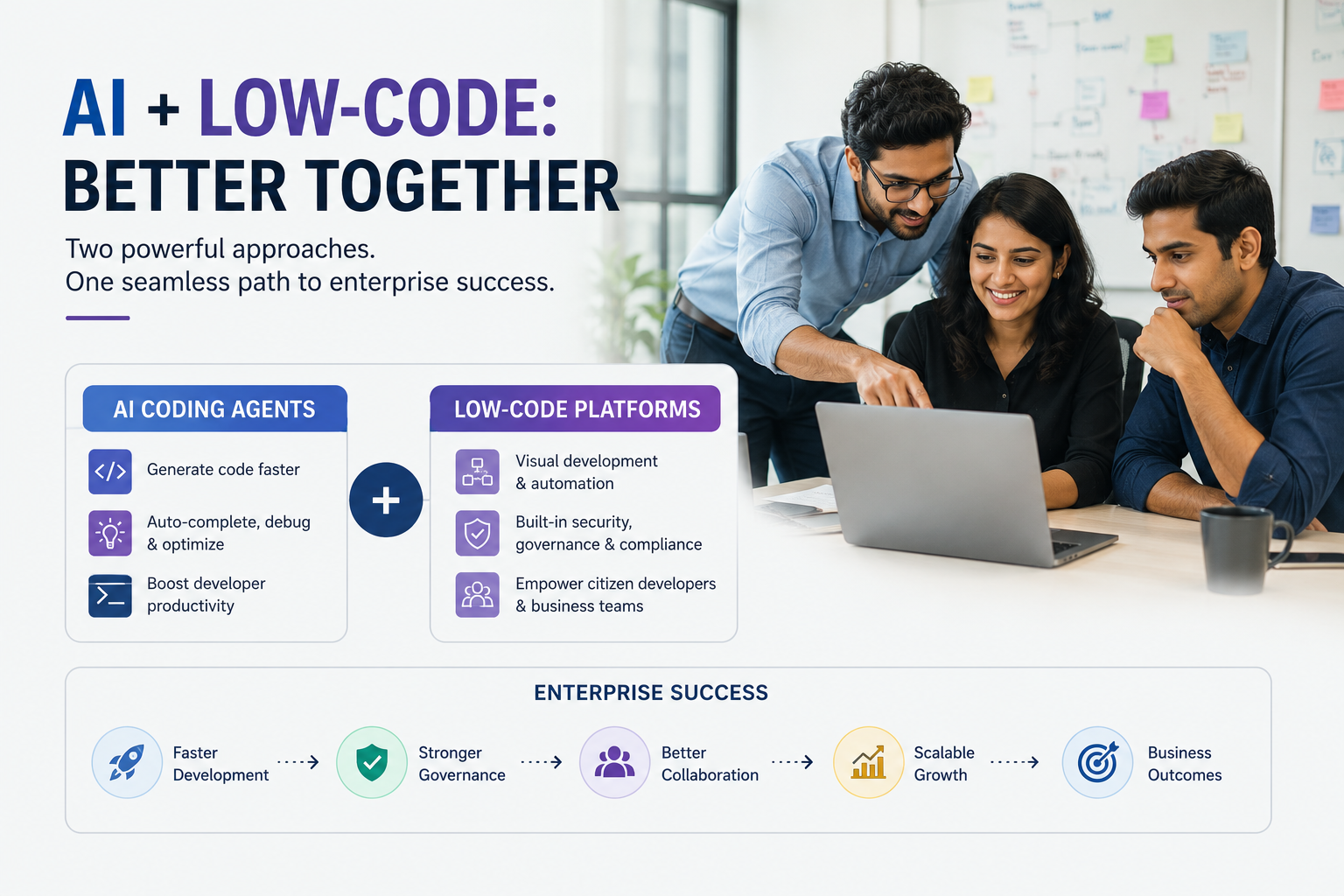
AI and Low-Code Are Better Together
Instead of competing, AI coding assistants and low-code platforms complement one another.
Developers can use AI to quickly create components, write business logic, or troubleshoot issues.
Low-code platforms then help transform those components into production-ready applications with governance, reusable workflows, integrations, and enterprise-grade reliability.
This combination offers:
Faster Development
Developers spend less time writing repetitive code.
Better Collaboration
Business users and developers can work together using visual workflows.
Reduced Technical Debt
Standardized architectures reduce long-term maintenance challenges.
Improved Governance
Applications remain compliant with security and organizational policies.
Empowering Both Developers and Business Teams
One of the greatest strengths of low-code is accessibility.
Professional developers can build complex applications faster, while business users can automate workflows without deep programming expertise.
AI makes this even more powerful.
Instead of manually creating workflows, users can describe their requirements in natural language, allowing AI to generate a starting point that developers can refine and govern.
This reduces development bottlenecks and improves innovation across departments.
Enterprise Software Requires More Than Code
Organizations don't simply need applications that work.
They need applications that remain secure, scalable, maintainable, and compliant over time.
Enterprise environments demand:
- Access control
- Audit trails
- Data governance
- Regulatory compliance
- Performance monitoring
- Continuous updates
- Disaster recovery
These requirements extend well beyond code generation and reinforce the ongoing importance of low-code platforms for enterprise development.
The Future Is Hybrid Development
Software development is entering a hybrid era.
Traditional programming, AI-assisted coding, and low-code development will coexist rather than replace one another.
Different projects require different approaches.
For example:
Project TypeBest ApproachInternal business workflowsLow-CodeEnterprise automationLow-Code + AICustom software productsAI-Assisted CodingComplex engineering systemsTraditional Coding + AIRapid prototypesAI Coding AgentsBusiness dashboardsLow-Code
Organizations that combine these approaches will deliver software faster while maintaining quality and governance.
Final Thoughts
The arrival of AI coding agents marks a significant milestone in software development, but it does not signal the end of low-code platforms. Instead, it highlights a shift toward smarter, more collaborative development practices.
AI excels at accelerating code creation, while low-code platforms provide the structure, governance, and scalability that enterprises need to deliver reliable business applications. Together, they create a powerful ecosystem that helps organizations innovate faster without sacrificing quality or control.
The future of software development isn't about choosing one approach over another—it's about leveraging AI and low-code together to build secure, scalable, and intelligent digital solutions that meet evolving business demands.