
The End of Traditional Engineering Productivity Benchmarks | Pure Tech
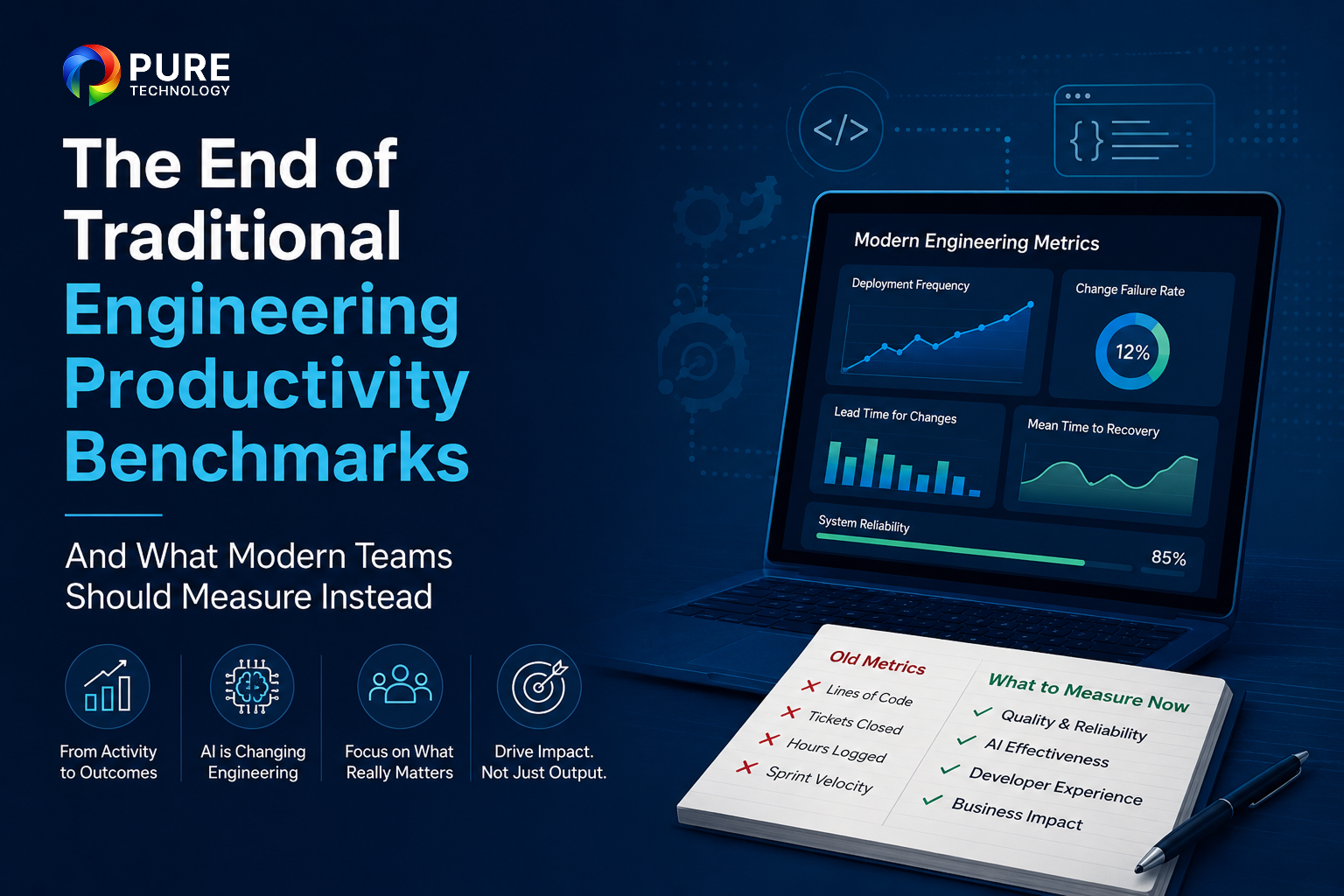
The End of Traditional Engineering Productivity Benchmarks and What Modern Teams Should Measure Instead
Engineering productivity used to be simple to evaluate. Companies measured lines of code written, tickets completed, sprint velocity, and hours worked. These metrics helped managers track output and compare team performance across projects.
For years, this model worked because software development was largely manual, linear, and predictable.
But software engineering in 2026 looks completely different.
AI-assisted development, distributed engineering teams, automation tools, and faster deployment cycles have transformed how software is built. Today, developers spend less time writing raw code and more time reviewing AI-generated suggestions, solving architectural problems, improving system reliability, and accelerating delivery outcomes.
As a result, traditional engineering productivity benchmarks no longer reflect actual business impact.
The conversation is shifting from:
“How much code are teams producing?”
to:
“How efficiently are teams creating business value?”
Modern engineering organizations are now focusing on outcome-driven productivity metrics rather than activity-based measurements.
Why Traditional Engineering Productivity Metrics Are Becoming Obsolete
Legacy engineering KPIs were designed for an era where developer productivity was directly tied to manual coding effort.
Metrics such as:
- Lines of code (LOC)
- Story points completed
- Number of commits
- Hours logged
- Tickets closed
were once considered indicators of productivity.
However, these measurements often fail to capture the real impact of engineering work.
For example:
- A developer who removes unnecessary code may significantly improve system performance and maintainability while appearing “less productive.”
- A team focused on technical debt reduction may temporarily release fewer features while dramatically improving long-term scalability.
- AI tools can now generate thousands of lines of code instantly, making code volume an unreliable productivity signal.
Traditional metrics measure activity.
Modern engineering organizations need metrics that measure outcomes, reliability, efficiency, and customer impact instead.
How AI Is Reshaping Engineering Productivity
AI-powered coding assistants have fundamentally changed software development workflows.
Developers are no longer spending most of their time typing code manually. Instead, engineering teams now focus on:
- Reviewing AI-generated code
- System design and architecture
- Security validation
- Performance optimization
- Problem-solving
- Product thinking
- Collaboration across teams
This shift creates a major gap in traditional productivity measurement.
If AI can generate production-ready code within minutes, then writing more code no longer guarantees higher productivity.
The true value now lies in:
- Making better technical decisions
- Delivering stable systems faster
- Reducing deployment failures
- Improving customer outcomes
- Maintaining code quality at scale
Modern productivity is increasingly defined by engineering effectiveness rather than engineering output.
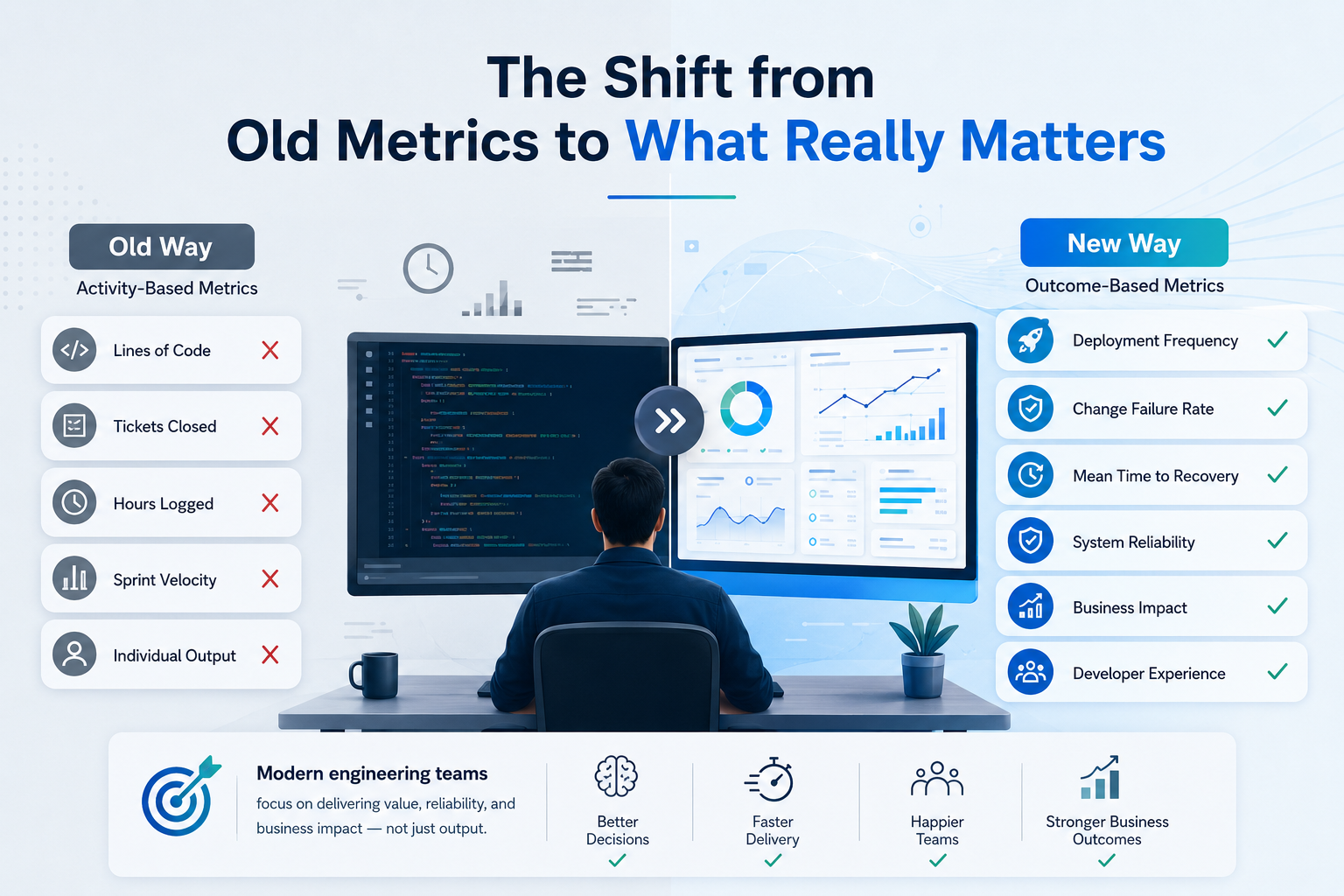
Modern Engineering Productivity Metrics That Actually Matter
1. Outcome Quality Metrics
Modern engineering teams prioritize software quality and system stability over raw coding volume.
Key metrics include:
Defect Escape Rate
Tracks how many bugs reach production after release.
A lower defect escape rate indicates better testing, review quality, and engineering discipline.
Mean Time to Recovery (MTTR)
Measures how quickly teams resolve incidents and restore services after failures.
Faster recovery times indicate stronger operational maturity and system resilience.
Change Failure Rate
Measures the percentage of deployments that result in incidents, rollbacks, or outages.
This is now one of the most valuable indicators of engineering effectiveness.
2. AI-Assisted Development Metrics
As AI-generated code becomes more common, engineering leaders are beginning to measure how effectively teams use AI tools.
Important metrics include:
- AI-generated code acceptance rate
- AI code modification frequency
- Review quality for AI-generated outputs
- Security validation success rate
- Human review depth and cycle time
These metrics help organizations ensure AI improves productivity without compromising software quality or security.
3. Developer Experience & Flow Metrics
Developer productivity is heavily influenced by workflow friction and cognitive load.
Modern organizations now track:
- Time spent in meetings vs. focused work
- Context switching frequency
- Developer onboarding speed
- Time to first meaningful contribution
- Internal tooling efficiency
- Workflow bottlenecks
Reducing engineering friction often improves productivity more than simply increasing development speed.
4. Technical Health Metrics
AI can accelerate delivery, but it can also increase technical debt if teams move too quickly.
That is why engineering leaders are now monitoring:
- Technical debt accumulation
- Test coverage quality
- Security vulnerability density
- Architecture consistency
- Code maintainability
- Infrastructure reliability
Long-term software sustainability is becoming just as important as release velocity.
5. Business Impact Metrics
Modern engineering performance must connect directly to business outcomes.
Key metrics now include:
- Time from idea to production
- Customer impact of released features
- Feature adoption rates
- Revenue contribution per engineering investment
- Engineering efficiency ratio
- Customer retention improvements
Organizations increasingly evaluate engineering success based on how effectively teams create measurable business value.
The Shift from Individual Productivity to System Productivity
One of the biggest changes in modern software engineering is the move away from measuring individuals in isolation.
Software development is highly collaborative.
Engineering success depends on:
- Communication quality
- Team coordination
- Dependency management
- Cross-functional collaboration
- Process efficiency
- Feedback loops
High-performing teams are not always the ones producing the most code.They are the teams that consistently deliver reliable customer value with minimal friction.
Engineering Productivity in Distributed & Offshore Teams
Distributed engineering teams are now a core part of global software delivery models.
As organizations expand engineering operations across regions like India, Eastern Europe, and Southeast Asia, measuring productivity becomes even more complex.
In distributed environments, success depends on:
- Clear communication
- Strong documentation
- Efficient collaboration
- Faster dependency resolution
- Shared ownership
- Workflow transparency
For offshore development models, engineering productivity is no longer about individual activity. It is about how effectively the entire system operates together.
Warning Signs Your Engineering Metrics Are Outdated
Many organizations still rely on outdated benchmarks that create misleading performance signals.
Common red flags include:
- Overemphasis on lines of code
- Measuring productivity through hours worked
- Comparing developers using ticket counts
- Ignoring system quality and stability
- Focusing only on sprint velocity
- Tracking output without business impact
These approaches often encourage short-term activity rather than long-term engineering excellence.
What Engineering Leaders Should Focus on Now
Modern engineering leadership is no longer about maximizing developer output.
It is about building systems that enable sustainable, high-quality delivery at scale.
Successful engineering organizations now focus on:
- Improving developer experience
- Reducing workflow bottlenecks
- Enhancing system reliability
- Encouraging collaboration
- Supporting AI-assisted development responsibly
- Aligning engineering metrics with business outcomes
The companies succeeding in the AI era are not the ones writing the most code.
They are the ones measuring the right things.
How Pure Tech Helps Organizations Build Modern Engineering Systems
At Pure Tech, we help businesses modernize their engineering operations for the AI-driven software era.
Our teams help organizations:
- Improve engineering productivity frameworks
- Build scalable offshore development models
- Optimize developer workflows
- Implement AI-assisted development practices
- Reduce delivery bottlenecks
- Strengthen engineering quality and reliability
As software engineering continues to evolve, organizations must move beyond outdated productivity benchmarks and adopt metrics that reflect real business value, engineering efficiency, and long-term scalability.