
Multi-Agent AI Systems: How Businesses Are Building Smarter AI Ecosystems in 2026
Multi-Agent AI Systems: How Businesses Are Building Smarter AI Ecosystems in 2026
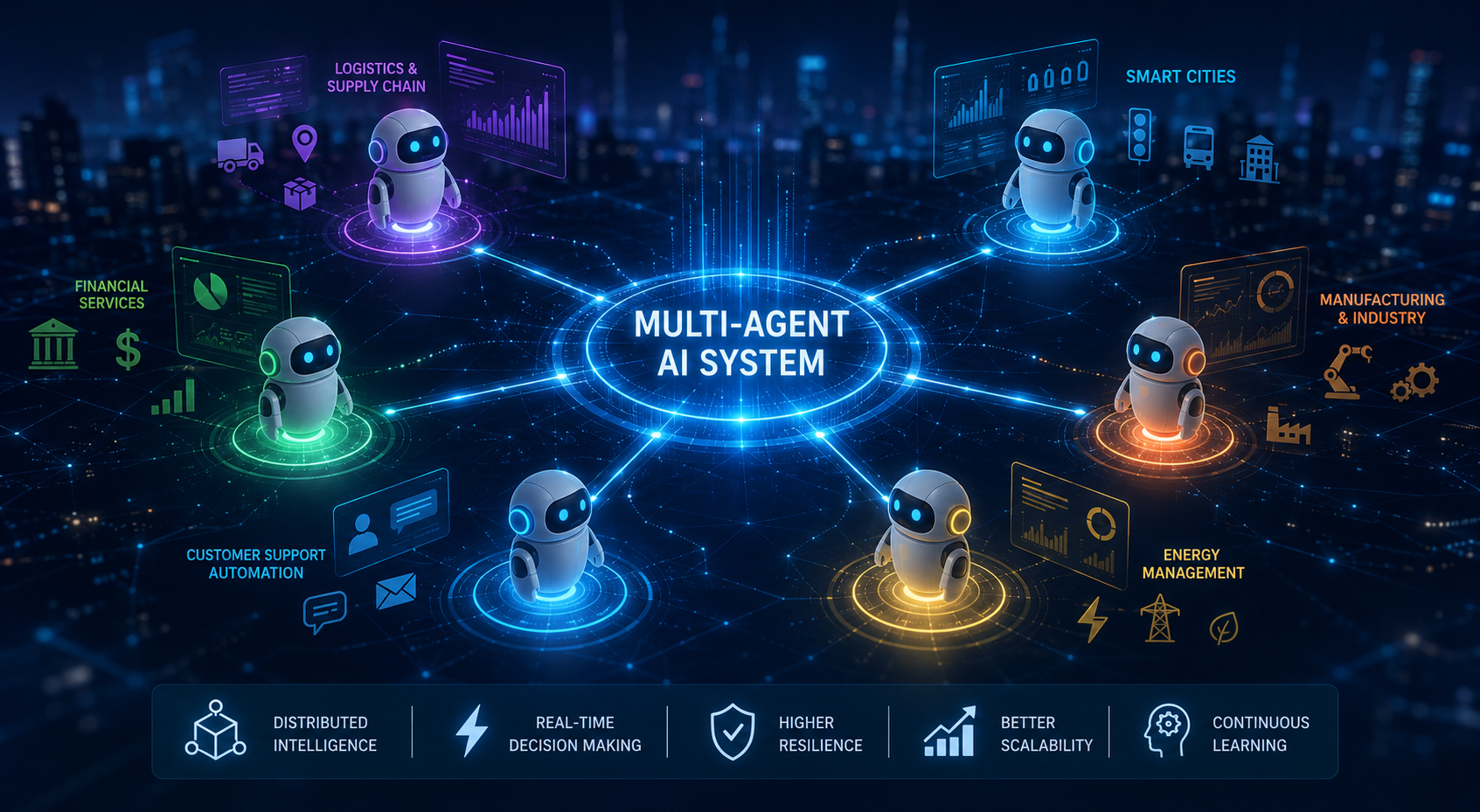
Artificial Intelligence is evolving beyond standalone chatbots and isolated automation tools. Today, businesses are moving toward multi-agent AI systems , a more advanced AI architecture where multiple intelligent agents collaborate, communicate, and make decisions together in real time.
From autonomous vehicles and smart cities to intelligent supply chains and financial trading platforms, multi-agent AI is redefining how businesses solve complex operational challenges.
In this blog, we’ll explore what multi-agent AI systems are, how they work, their business applications, benefits, challenges, and why they are becoming essential for future-ready enterprises.
What is a Multi-Agent AI System?
A multi-agent AI system consists of multiple intelligent AI agents operating within a shared environment. Each agent has its own goals, decision-making capabilities, and perspective while interacting with other agents to complete tasks efficiently.
Unlike traditional single-agent AI models that handle tasks independently, multi-agent systems distribute intelligence across multiple entities. These agents can collaborate, compete, or function autonomously depending on the use case.
This distributed architecture allows organizations to solve highly dynamic and large-scale problems more effectively than a single AI model.
Businesses increasingly rely on advanced AI agent development services to build scalable multi-agent ecosystems for automation, analytics, and operational optimization.
How Does a Multi-Agent AI System Work?
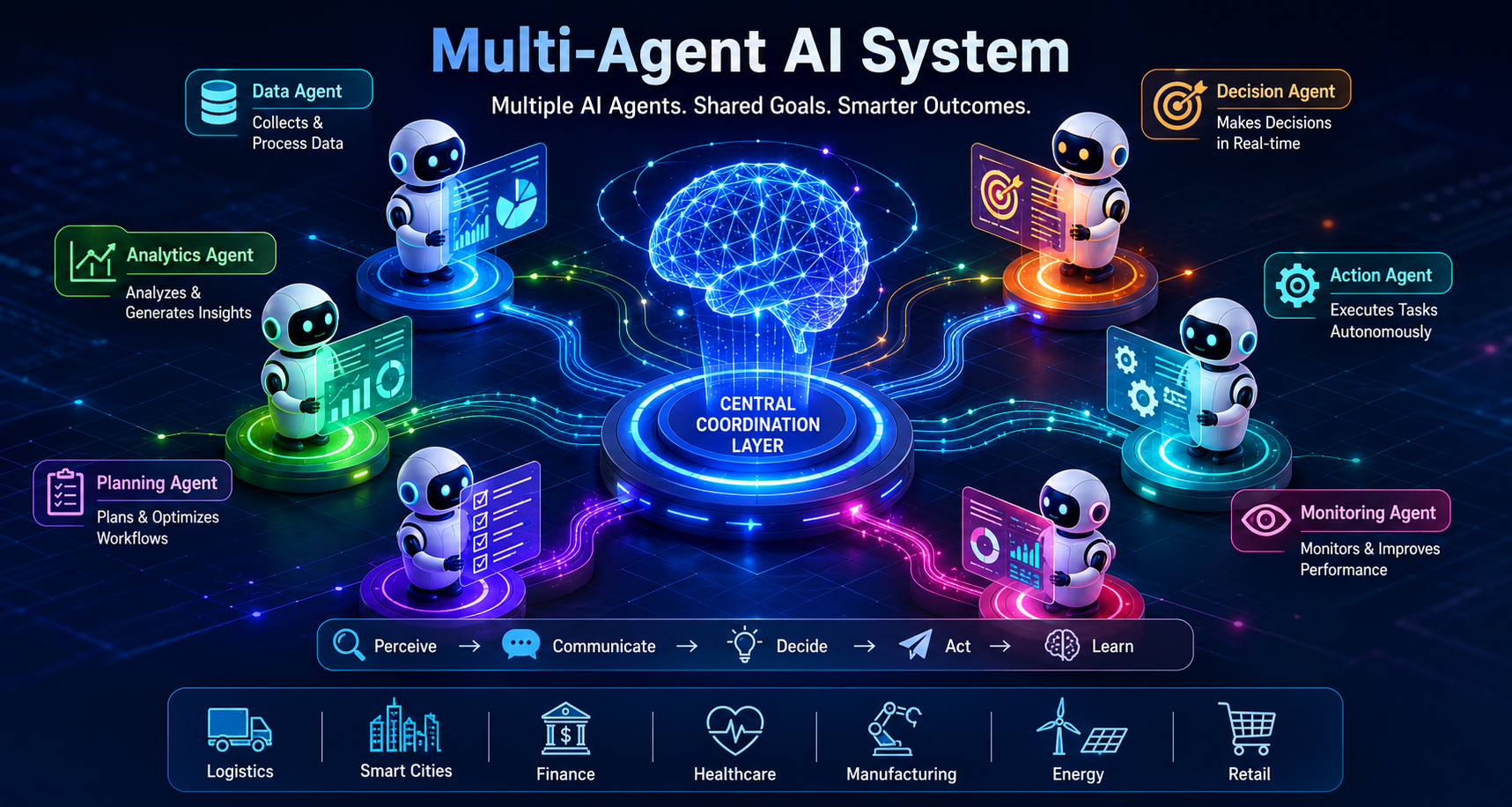
A multi-agent AI system functions through continuous interaction between intelligent agents and their environment.
1. Perception of the Environment
Each agent gathers information from its surroundings through sensors, APIs, databases, or data streams. The environment may be physical, like a manufacturing floor, or digital, like a stock market platform.
Agents collect localized information relevant to their assigned responsibilities.
2. Autonomous Decision-Making
Once data is collected, each agent independently analyzes information and makes decisions using machine learning models, predefined rules, or predictive algorithms.
These decisions are aligned with specific objectives while contributing to broader system goals.
3. Communication and Coordination
Agents continuously exchange information with one another using communication protocols.
This coordination helps agents:
- Avoid duplicated efforts
- Resolve conflicts
- Share updates
- Synchronize workflows
- Improve overall efficiency
Collaborative intelligence becomes the foundation of system performance.
4. Task Execution and Interaction
Agents execute tasks that directly impact the environment or influence other agents.
For example:
- Delivery agents optimize logistics routes
- Financial agents monitor market trends
- Smart grid agents balance energy consumption
Each action contributes to the system’s larger operational objective.
5. Feedback and Learning
Modern multi-agent AI systems incorporate learning mechanisms such as:
- Reinforcement learning
- Deep learning
- Game theory
- Behavioral optimization
Agents continuously improve their decision-making based on outcomes and environmental feedback.
6. Emergent Intelligence
One of the most powerful aspects of multi-agent AI is emergent behavior. Complex problem-solving capabilities emerge from relatively simple interactions between agents without requiring centralized control.
This allows businesses to optimize:
- Logistics networks
- Traffic systems
- Energy grids
- Customer support operations
- Financial ecosystems
Key Use Cases of Multi-Agent AI Systems
Autonomous Vehicles
Self-driving ecosystems rely heavily on multiple AI agents.
Vehicles, traffic infrastructure, navigation systems, and smart sensors communicate continuously to:
- Prevent collisions
- Reduce traffic congestion
- Optimize fuel efficiency
- Improve passenger safety
This collaborative intelligence enables safer and smarter transportation systems.
Supply Chain & Logistics
Multi-agent AI is transforming modern logistics operations.
Different agents manage:
- Warehousing
- Fleet movement
- Demand forecasting
- Inventory management
- Supplier coordination
By working together in real time, these agents improve operational efficiency and reduce delivery delays.
Smart Cities
Smart city infrastructure depends on interconnected AI agents managing:
- Traffic lights
- Public transport
- Water systems
- Energy grids
- Emergency services
These agents dynamically respond to changing urban conditions and optimize city-wide resource utilization.
Financial Market Prediction
Financial institutions use multi-agent AI systems for:
- Real-time trading
- Risk assessment
- Fraud detection
- Portfolio management
- Market trend prediction
Each agent may focus on different trading strategies while collaborating to optimize investment outcomes.
Benefits of Multi-Agent AI Systems for Businesses, Better Scalability
Multi-agent systems are modular by design. Businesses can:
- Add new agents easily
- Expand operations efficiently
- Handle larger datasets
- Scale automation without rebuilding systems
This flexibility supports long-term growth.
Faster Decision-Making
Distributed intelligence allows agents to process information simultaneously. This reduces delays and enables:
- Real-time analytics
- Faster automation
- Immediate response to market changes
- Better operational efficiency
Higher System Resilience
If one agent fails, the remaining agents can continue functioning. This decentralized architecture improves:
- System reliability
- Operational continuity
- Fault tolerance
- Risk management
It is especially valuable for mission-critical industries.
Improved Adaptability
Multi-agent systems adapt quickly to:
- Market fluctuations
- Customer behavior changes
- Operational disruptions
- Environmental conditions
Challenges of Multi-Agent AI Systems
Communicaiton Latency :
- Real-time decision-making
- Synchronization
- Operational accuracy
Agent Alignment Issues
Agents may prioritize local objectives that conflict with global system goals. Without proper coordination:
- Inefficiencies may occur
- Conflicts may arise
- System performance may decline
Security Risks
Multi-agent environments can become vulnerable to:
- Malicious agents
- Data manipulation
- Unauthorized access
- Communication hijacking
Transparency and Debugging
Because decisions emerge through decentralized interactions, debugging can become complex. Businesses need:
- Explainable AI frameworks
- Monitoring systems
- AI governance tools
- Transparency protocols
Why Multi-Agent AI is the Future of Enterprise Automation
As businesses deal with increasingly complex digital ecosystems, traditional AI models often struggle to scale effectively. Multi-agent AI systems provide:
- Distributed intelligence
- Autonomous collaboration
- Real-time adaptability
- Resilient automation
- Scalable enterprise operations
Industries such as logistics, healthcare, finance, manufacturing, and smart infrastructure are rapidly adopting this architecture to gain competitive advantages.
Organisations investing in multi-agent AI today are preparing themselves for the next generation of intelligent automation.
Final Thoughts
Multi-agent AI systems are reshaping how enterprises approach automation, decision-making, and operational intelligence.
By enabling multiple AI agents to collaborate dynamically, businesses can create systems that are more scalable, adaptive, resilient, and efficient than traditional AI models.
As AI adoption accelerates in 2026 and beyond, multi-agent architectures will become a core foundation for future-ready enterprises.
Whether your business aims to optimize operations, automate complex workflows, or build intelligent ecosystems, multi-agent AI can unlock entirely new levels of innovation and performance.
Ready to Build Intelligent AI Systems?
At Pure Technology, we help businesses develop scalable AI-powered solutions tailored to modern enterprise needs.
From AI agent development services to advanced automation systems, our experts can help you transform complex operations into intelligent digital ecosystems.
Contact our team today to explore how multi-agent AI can accelerate your business growth.