
How to Plan an Annual Maintenance Budget for Manufacturing Plants
How to Plan an Annual Maintenance Budget for Manufacturing Plants
Every budget season, the same scene plays out on plant floors across the country: a maintenance manager submits a number based on last year's spend plus a reasonable-sounding increase, and finance cuts it because there's no data behind the ask. Six months later, the "savings" from that cut shows up as an emergency repair bill that costs more than the original request ever would have.
The problem usually isn't that maintenance budgets are too high. It's that most of them are built on gut feel instead of asset data — which makes them easy to argue with and easy to cut. Here's how to build one that finance can't easily dismiss.
Prioritize Capital Requests With a Simple Risk Matrix
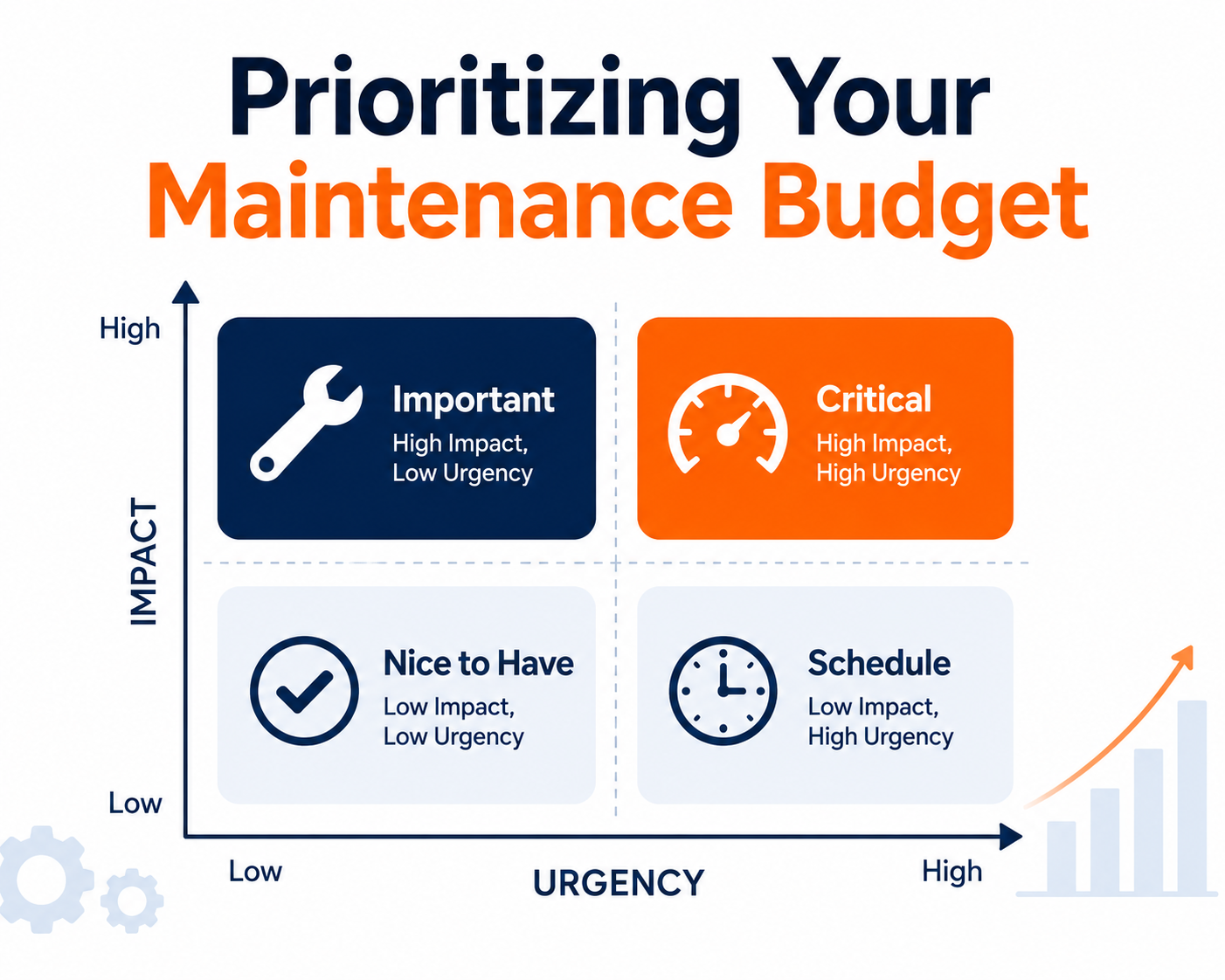
Capital is always limited, so sort every deferred item by probability of failure against consequence of failure before you ask for money:
- High probability, high impact — fund first. Equipment already showing degradation where failure stops production.
- Low probability, high impact — plan into the next cycle, with condition monitoring in the interim.
- High probability, low impact — address opportunistically, usually bundled into routine PM rather than a standalone capital request.
- Low probability, low impact — monitor and defer; revisit only if the risk profile changes.
This turns the budget conversation from "why do you need more money" into "here's the most efficient use of what we have" — a much easier case for finance to say yes to.
Build a Multi-Year Forecast, Not Just an Annual Number
A budget that only looks twelve months out forces every major replacement into a last-minute scramble the year it finally becomes unavoidable. A rolling five-year capital forecast changes that:
- It smooths capital spend so major replacements don't collide in the same fiscal year by coincidence.
- It uses condition data instead of calendar age, since two identical assets installed the same year can have very different remaining useful life depending on duty cycle and environment.
- It converts surprises into planned line items — a replacement finance sees for the first time this budget cycle looks like an emergency; the same replacement visible on a forecast for two prior years looks like execution.
This forecast doesn't need to predict the future perfectly. It needs an honest asset register — install dates, condition scores, documented replacement triggers — kept current as a living document rather than reconstructed once a year under deadline pressure.
Watch These Three Warning Signs
- Labor above 50% of total budget often signals a reactive-heavy operation where emergency overtime is quietly inflating costs.
- Parts spend above 35% may point to weak PM scheduling — reactive parts purchases typically carry a real premium over the same parts ordered on a planned cycle.
- Zero contingency reserve isn't lean budgeting — it's deferred risk waiting to surface as a mid-year supplemental request, usually at the worst possible time.
Five Mistakes That Sink a Budget Request Before Finance Reads the Total
- Estimating from a flat percentage of revenue. Revenue has no direct relationship to how many assets you maintain or how old they are.
- Blending OpEx and CapEx into one number. Finance needs them separated for tax and reporting; a mixed request forces manual rework and invites closer scrutiny.
- Presenting cost without consequence. "₹15 lakh for additional PM labor" is a cost. "₹15 lakh that raises PM compliance from 70% to 90% and is projected to prevent ₹1 crore in downtime" is a business case.
- Treating the approved budget as fixed. A number set once a year and never revisited can't absorb the unplanned failure that will inevitably happen. Review monthly against actuals.
- Requesting capital without a disposal plan. A replacement request that ignores what happens to the old asset — resale value, disposal cost, transition downtime — reads as incomplete.
The Real Cost of an Unproven Budget
Consider a plant that submits an ₹1.8 crore maintenance budget with no supporting data. Leadership cuts it to ₹1.2 crore because the maintenance director can't explain a 22% labor increase or point to which equipment would fail without the requested PM schedule. Within six months, unplanned failures cost ₹68 lakh in downtime and emergency repairs, the PM backlog balloons, and a mid-year supplemental request follows. By year end, actual spend exceeds the original ask by a wide margin — plus the operational cost of the failures themselves.
The cut wasn't the failure. Leadership is entitled to scrutinize spending. The failure was that the original request had no data to make that scrutiny productive. A budget backed by asset-level cost history and a documented risk-scored backlog turns the conversation from a negotiation over trust into a review of evidence — and evidence-backed requests fare better regardless of how sympathetic any individual reviewer feels toward the underlying need.
How Pure Technology Helps
We work with manufacturing clients on the MES and industrial digitization side, which means asset-level cost history, PM compliance, and failure data often already exist somewhere in the plant — just scattered across spreadsheets, machine logs, and paper records instead of one place a maintenance leader can pull a budget case from in an afternoon. Part of what we build is exactly that: consolidating existing plant data into the RAV benchmarks, planned-versus-reactive ratios, and backlog risk scoring that make a budget request defensible before it ever reaches finance.
If your team is heading into budget season without a clean way to pull this data together, we're happy to talk through what a lightweight digitization project could look like for your plant.