
How to Choose the Right Software Development Partner in the AI Era

How to Choose the Right Software Development Partner in the AI Era
Artificial Intelligence has transformed the software industry faster than most businesses anticipated. Choosing a software development partner is no longer just about comparing hourly rates, team sizes, or programming languages.
In 2026, companies need partners who can build intelligent, scalable, AI-ready digital products not just software applications.
Modern software development now includes AI-assisted coding, automated testing, predictive analytics, autonomous workflows, and cloud-native infrastructure. Businesses that choose outdated development models risk building products that become obsolete within months.
The right development partner today is one that combines engineering expertise, AI-driven delivery processes, product strategy, and long-term scalability thinking.
Organizations are no longer asking:
“Can this company build our software?”
They are asking:
“Can this partner help us stay competitive in the AI-driven future?”
Why Traditional Vendor Selection No Longer Works
Previously, companies evaluated development vendors using factors like:
- Cost per developer
- Team size
- Delivery timelines
- Technology stack familiarity
- Offshore pricing advantages
While these factors still matter, they are no longer enough.
AI has significantly accelerated software delivery cycles. Developers now use AI-powered tools for coding assistance, testing automation, debugging, and deployment optimization.
As a result, the best software development partners are not necessarily the ones with the largest teams — they are the ones with the smartest delivery systems.
Businesses now need partners capable of:
- AI-assisted development
- Faster iteration cycles
- Scalable cloud architecture
- Strong security governance
- Product-focused decision-making
- Continuous innovation
The evaluation process must evolve accordingly.
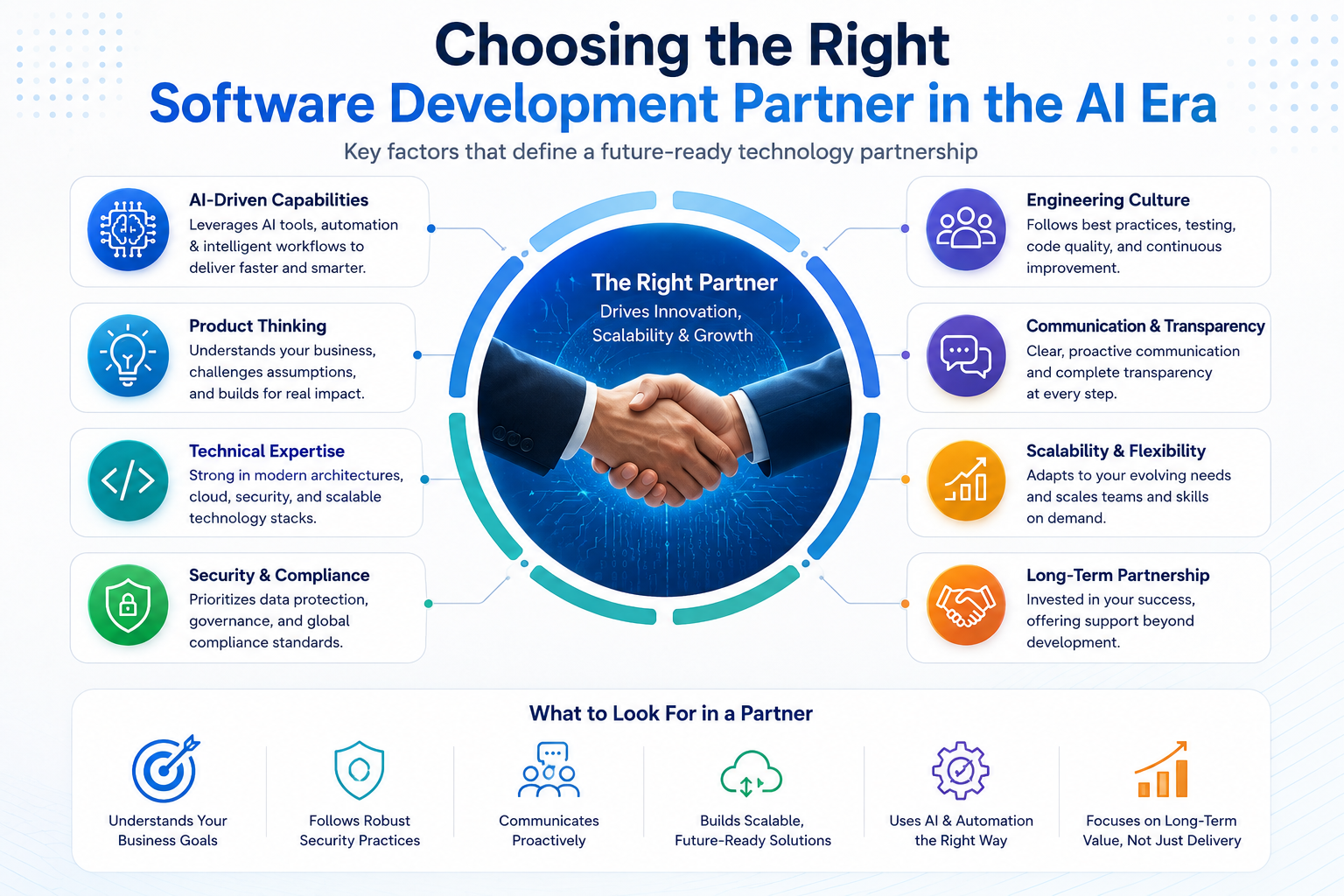
Key Factors to Evaluate When Choosing a Software Development Partner
1. AI-Driven Development Capabilities
AI has become deeply integrated into modern software engineering workflows.
A capable development partner should already be leveraging:
- AI coding assistants
- Automated testing frameworks
- AI-driven quality assurance
- Intelligent DevOps automation
- Predictive analytics tools
- AI-powered productivity systems
The goal is not simply writing code faster.
It is about improving software quality, reducing repetitive tasks, and enabling engineering teams to focus on architecture, business logic, and innovation.
Questions to Ask
- How does your team use AI in the development lifecycle?
- What processes ensure AI-generated code quality?
- How do you balance automation with human oversight?
- What safeguards exist for AI-assisted development?
A modern engineering partner should demonstrate both speed and engineering discipline.
2. Product Thinking & Strategic Mindset
The strongest software partners do more than execute technical tasks.
They think like product builders.
A product-focused development company will:
- Understand your business goals
- Analyze user experience challenges
- Suggest better workflows
- Recommend scalable architectures
- Identify product risks early
- Contribute strategic insights
This approach helps businesses avoid costly technical mistakes and short-sighted product decisions.
Signs of a Product-Minded Partner
- They ask about business objectives before discussing pricing.
- They challenge weak assumptions constructively.
- They suggest improvements instead of blindly following requirements.
- They focus on customer outcomes, not just feature delivery.
A true technology partner becomes an extension of your business rather than an outsourced vendor.
3. Technical Architecture Expertise
Building software is one thing.
Building scalable, maintainable, and future-proof systems is another.
Your development partner should possess strong expertise in:
- Cloud-native architecture
- API-first development
- Microservices
- Serverless systems
- Scalable databases
- Security frameworks
- Infrastructure automation
Technical depth becomes especially important as products scale.
Weak architecture decisions often lead to:
- Rising technical debt
- Performance bottlenecks
- Security vulnerabilities
- Expensive rebuilds
- Poor scalability
Important Questions to Ask
- How do you design systems for long-term scalability?
- What is your approach to reducing technical debt?
- How do you ensure infrastructure reliability?
- How do you future-proof applications?
Experienced engineering teams think beyond immediate delivery.
They think in systems.
4. AI Governance, Security & Compliance
As AI adoption grows, data governance has become one of the most important evaluation criteria.
Your software development partner must take security and compliance seriously.
This includes:
- Secure AI workflows
- Data privacy controls
- PII masking strategies
- Secure cloud infrastructure
- Regulatory compliance readiness
- Ethical AI practices
Businesses handling sensitive customer data cannot afford weak governance practices.
What to Evaluate
- Data residency policies
- Security testing procedures
- Compliance experience (GDPR, HIPAA, SOC 2, etc.)
- AI model monitoring practices
- Internal access controls
Security should be embedded into development processes from day one — not added later.
The Importance of Engineering Culture
A company’s engineering culture directly affects software quality.
Strong engineering teams usually demonstrate:
- Structured code reviews
- Automated testing
- CI/CD pipelines
- DevOps maturity
- Documentation discipline
- Continuous improvement practices
Healthy engineering culture creates consistency, accountability, and better long-term outcomes.
Ask About Their Engineering Practices
- What does your QA process look like?
- How do you handle deployments and rollbacks?
- What percentage of testing is automated?
- How do you manage production incidents?
Detailed, process-oriented answers usually indicate operational maturity.
Industry & Domain Experience Matters
Software development becomes significantly more efficient when a partner understands your industry.
Domain expertise helps teams understand:
- Industry regulations
- Customer behavior
- Integration ecosystems
- Business workflows
- Security requirements
- Operational constraints
This reduces onboarding time and minimizes costly misunderstandings.
Industries Where Domain Expertise Is Critical
- Healthcare
- Fintech
- Ecommerce
- SaaS platforms
- Logistics
- Manufacturing
- Enterprise software
A partner familiar with your industry can often identify problems before they happen.
Communication & Collaboration Are Critical
Many software partnerships fail because of poor communication rather than poor technical skills.
A reliable development partner should offer:
- Transparent communication
- Clear reporting structures
- Fast response times
- Proactive risk escalation
- Strong project management
The best teams communicate like internal stakeholders rather than external contractors.
Evaluate Communication Early
Look for:
- Clarity during discovery calls
- Responsiveness to questions
- Transparency about risks
- Realistic timelines
- Organized workflows
The evaluation phase often reflects how the long-term relationship will function.
Scalability & Team Flexibility
Your product needs will evolve over time.
A strong development partner should be capable of scaling teams up or down depending on project demands.
Evaluate whether they can provide:
- Backend developers
- Frontend specialists
- AI engineers
- DevOps experts
- QA engineers
- UI/UX designers
- Cloud architects
- Security specialists
Flexibility is extremely valuable in rapidly changing product environments.
Why Pilot Projects Reduce Risk
Instead of committing to a large engagement immediately, many businesses now begin with a smaller pilot project.
A pilot engagement helps evaluate:
- Delivery quality
- Communication patterns
- Engineering capabilities
- Team collaboration
- Workflow maturity
Even a short 4–6 week engagement can reveal how a company operates under real conditions.
Reliable partners are usually comfortable starting with smaller validation projects.
Red Flags to Watch For
Some warning signs become obvious only after projects begin.
Pay attention to these early indicators:
- Unrealistically low pricing
- Vague technical explanations
- Poor communication habits
- No architectural thinking
- Weak documentation standards
- Overpromising timelines
- Lack of QA maturity
Choosing purely based on cost often leads to expensive long-term consequences.
Why Businesses Choose Pure Tech for Modern Software Development
At Pure Tech, we help organizations build scalable, AI-ready software products designed for long-term growth.
Our teams combine:
- AI-assisted engineering workflows
- Product-focused development
- Modern cloud architecture
- DevOps & automation expertise
- UI/UX strategy
- Scalable offshore development models
We focus on building software systems that are secure, future-ready, and aligned with real business outcomes.
As AI continues reshaping the technology landscape, businesses need development partners who understand both engineering excellence and product innovation.
The right partnership today can define your competitive advantage for years to come.