
How AI Agents & LLMs Are Transforming Intelligent Document Processing (IDP)
How AI Agents and LLMs Are Transforming Intelligent Document Processing (IDP)
Businesses generate thousands of documents every day—from invoices and contracts to purchase orders, customer emails, insurance claims, and compliance reports. While organizations have automated many repetitive tasks over the years, document-heavy workflows have remained one of the biggest operational challenges.
Today, that is rapidly changing.
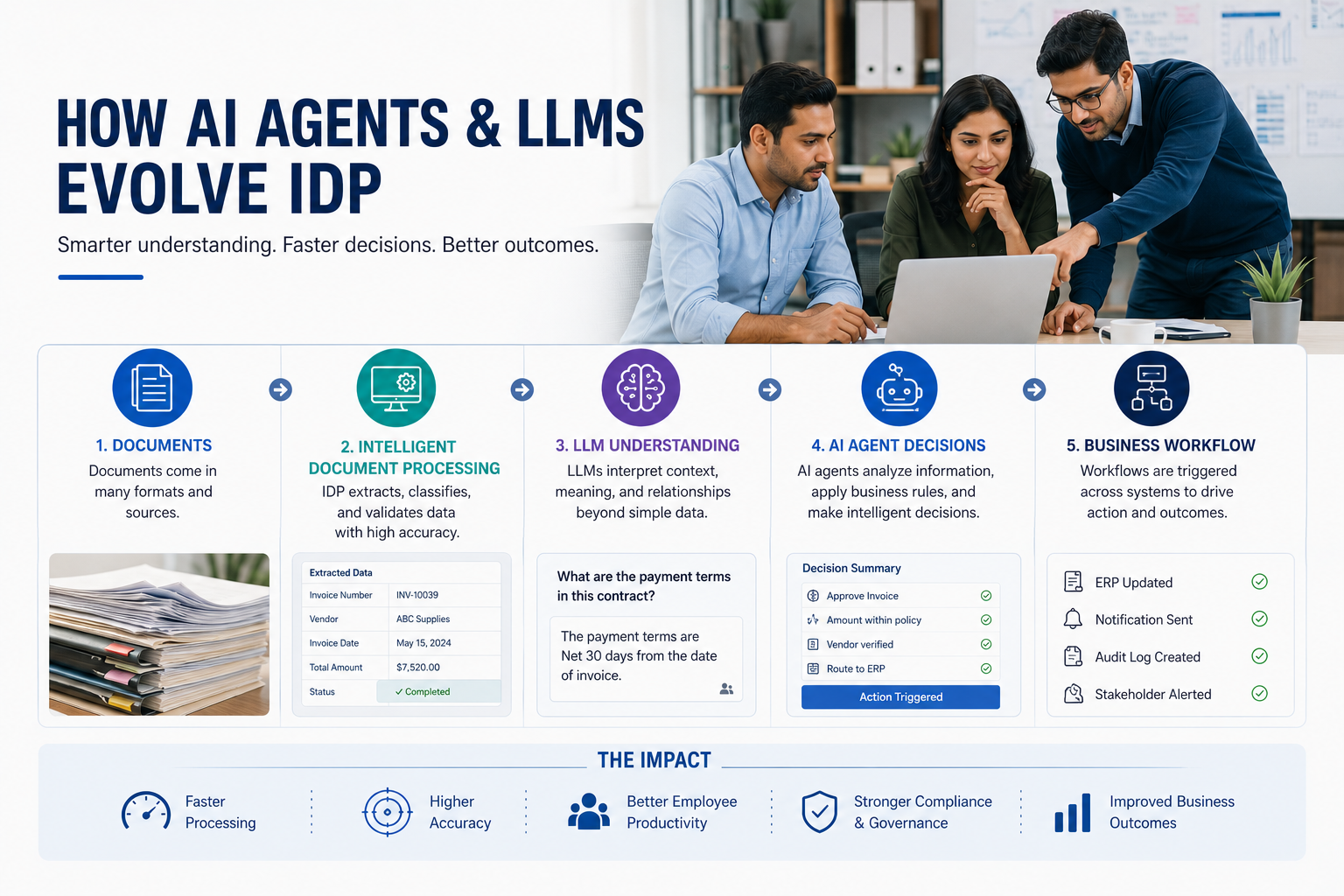
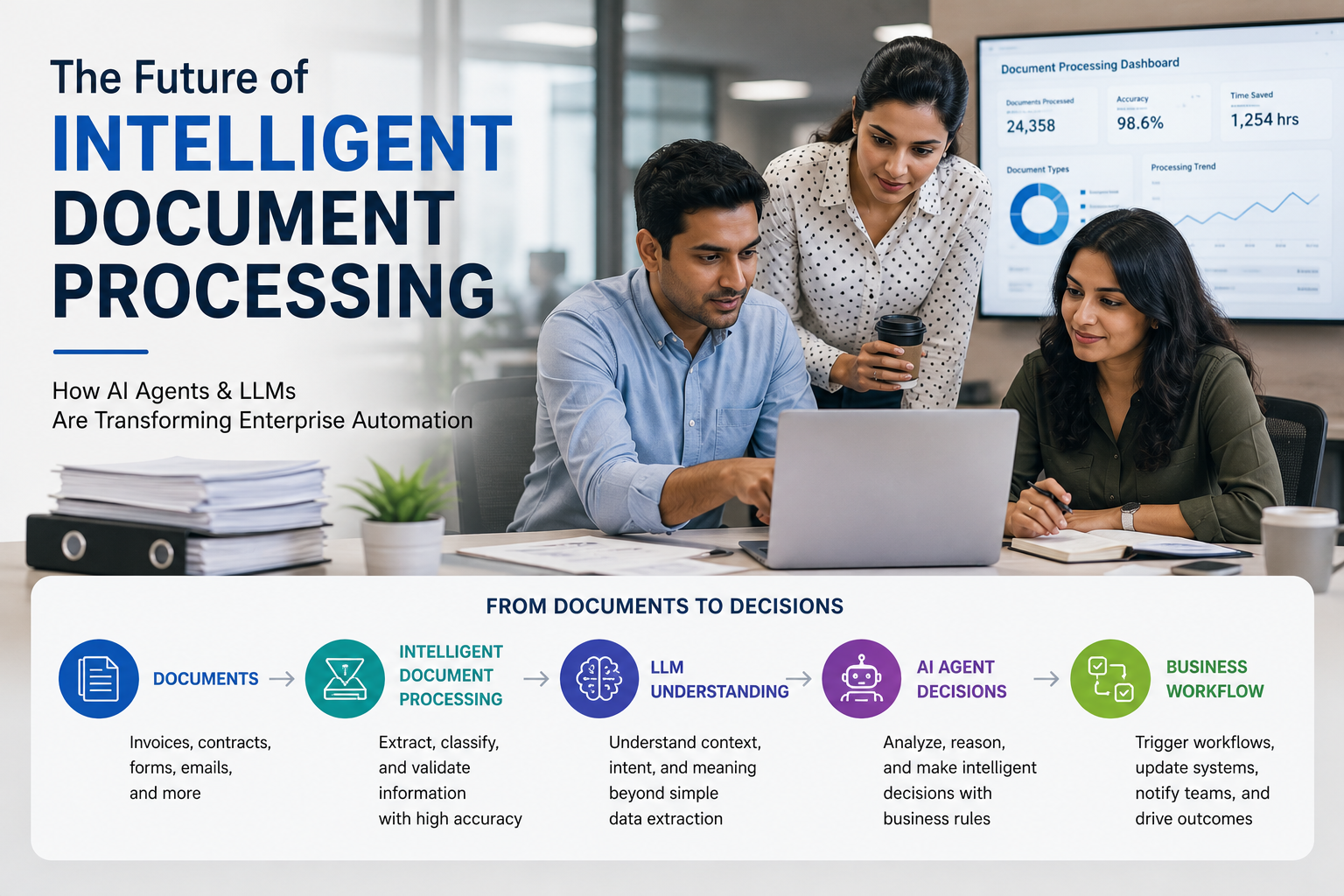
The combination of Artificial Intelligence (AI) agents, Large Language Models (LLMs), and Intelligent Document Processing (IDP) is redefining how businesses extract, understand, validate, and act on information. Instead of simply reading documents, modern AI systems can interpret context, automate decisions, and trigger complete business workflows.
However, one important misconception still exists: AI agents do not replace Intelligent Document Processing—they make it even more powerful. Modern enterprises increasingly combine structured document extraction with AI reasoning to automate complex, document-centric processes while maintaining governance and accuracy.
Why Traditional Document Processing Falls Short
Traditional OCR (Optical Character Recognition) systems were designed primarily to convert printed text into machine-readable data. While effective for standardized forms, they often struggle with:
- Unstructured contracts
- Multi-page legal documents
- Emails and conversations
- Financial statements
- Tables and handwritten notes
- Mixed document formats
As businesses deal with increasingly diverse content, simply extracting text is no longer enough.
Organizations need systems that understand context, relationships, and business intent.
How Large Language Models Are Changing Document Understanding
Large Language Models have introduced a new level of intelligence to document processing.
Instead of identifying only predefined fields, LLMs can understand:
- Context
- Intent
- Relationships between data
- Long-form documents
- Natural language instructions
For example, an LLM can analyze a 60-page supplier agreement and answer questions such as:
- What are the payment terms?
- When does the contract expire?
- Which clauses introduce financial risk?
- Are there penalties for early termination?
This enables businesses to retrieve meaningful insights rather than just raw text.
Why AI Agents Still Need Intelligent Document Processing
Many assume AI agents can simply read documents directly.
While technically possible, enterprise environments require far more than basic language understanding.
Organizations expect:
- High accuracy
- Auditability
- Compliance
- Structured outputs
- Human review when necessary
- Consistent performance at scale
IDP provides this foundation by delivering clean, validated, and structured information before AI agents begin reasoning or taking action. In enterprise workflows, reliable document understanding remains a prerequisite for trustworthy AI decisions.
The Evolution from Extraction to Business Decisions
Earlier generations of IDP focused primarily on extracting fields like:
- Invoice numbers
- Dates
- Vendor names
- Customer information
Today's intelligent systems go much further.
Modern document processing platforms help organizations answer questions such as:
- What decision should this document trigger?
- Is human approval required?
- Which department owns this process?
- Does the document violate compliance policies?
- Which workflow should execute next?
This evolution transforms documents into active participants within enterprise automation.
Real-World Applications Across Industries
Banking & Financial Services
Banks use AI-powered document processing to accelerate:
- Loan approvals
- Credit verification
- KYC processing
- Mortgage applications
- Financial statement analysis
Processing times that once took days can now be reduced to hours.
Healthcare
Healthcare organizations automate:
- Patient registration
- Medical claims
- Insurance verification
- Clinical documentation
- Referral management
This reduces administrative work while improving patient experiences.
Insurance
Insurance companies process thousands of documents daily.
Modern IDP solutions help automate:
- Claims processing
- Policy validation
- Fraud detection
- Damage assessments
- Customer communication
Best Practices for Implementing AI-Powered IDP
Organizations planning to modernize document processing should:
- Start with high-volume document workflows.
- Combine OCR, IDP, LLMs, and AI agents instead of relying on a single technology.
- Build governance and validation into every workflow.
- Keep humans involved for complex or high-risk decisions.
- Continuously train models using business feedback.
These practices improve accuracy while ensuring scalable and reliable automation.
Final Thoughts
Artificial Intelligence is changing how organizations work with documents, but it is not eliminating the need for Intelligent Document Processing. Instead, AI agents and Large Language Models are expanding IDP into a more intelligent, context-aware, and action-oriented capability.
By combining structured data extraction, contextual reasoning, workflow automation, and human oversight, businesses can process documents faster, reduce manual effort, improve compliance, and make better decisions at scale. The organizations that integrate AI agents with modern IDP will be best positioned to automate complex document-driven processes while maintaining the accuracy and governance required in enterprise environments.