
Future-Ready Global Capability Centers (GCCs): AI, Skills & Workforce Strategy
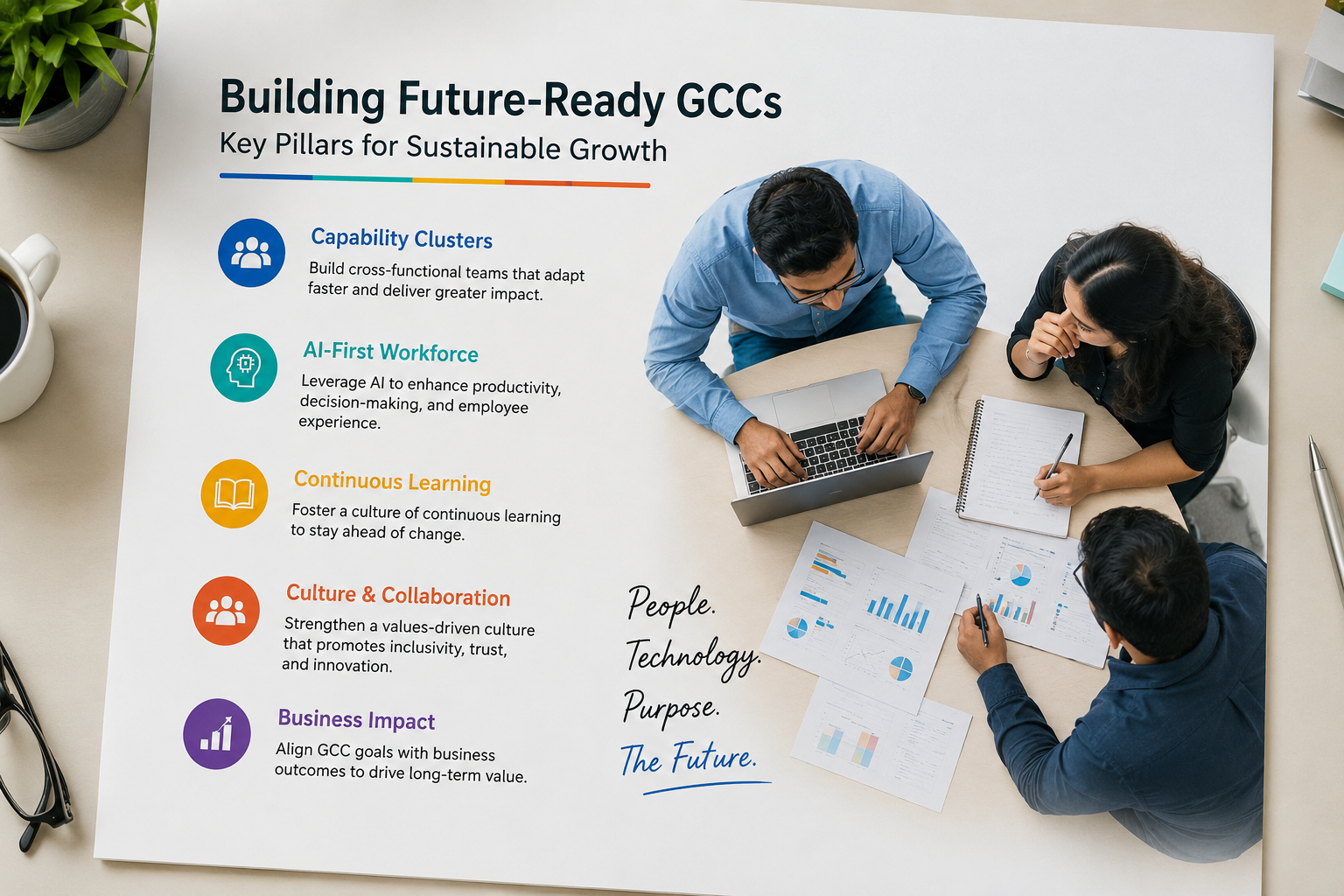
Future-Ready Global Capability Centers: How AI, Skills, and Culture Are Redefining Enterprise Success
Global Capability Centers (GCCs) have evolved far beyond their original purpose of reducing operational costs. Today, they are becoming strategic innovation hubs that drive digital transformation, accelerate AI adoption, and create business value across global enterprises.
As organizations compete in an AI-driven economy, the question is no longer whether a GCC should support business operations. Instead, the focus has shifted toward designing GCCs that can continuously adapt to changing technologies, evolving customer expectations, and rapidly transforming skill requirements.
This new generation of GCCs is built on intelligent workforce planning, continuous learning, and a culture that encourages innovation rather than simply executing predefined tasks.
Why Traditional GCC Models Are Becoming Obsolete
For many years, Global Capability Centers were measured by their ability to deliver services efficiently and at lower costs. While operational excellence remains important, businesses now expect much more.
Modern enterprises require GCCs that can:
- Lead product innovation
- Build AI-powered solutions
- Own end-to-end business functions
- Support global decision-making
- Drive digital transformation initiatives
- Create intellectual property
Organizations that continue treating GCCs as back-office support functions risk falling behind competitors that leverage them as innovation engines.
Capability-Based Workforce: The Future of Talent Strategy
Hiring people for fixed job roles is becoming increasingly ineffective.
Technology changes rapidly, and skills that are valuable today may become outdated within a few years—or even months.
Instead of focusing on job titles, successful organizations are creating capability clusters.
A capability cluster groups professionals with complementary skills who can easily transition across projects and business functions.
For example, instead of hiring only:
- Data Engineers
- Machine Learning Engineers
- Data Analysts
- AI Developers
A future-ready GCC develops an AI Capability Cluster where employees continuously expand their expertise and collaborate across multiple disciplines.
This approach enables organizations to:
- Respond faster to market changes
- Reduce dependency on external hiring
- Improve workforce flexibility
- Increase employee growth opportunities
- Accelerate innovation
AI Is Reshaping Workforce Planning
Artificial Intelligence is changing not only products and services but also how organizations manage talent.
Leading enterprises are now using AI to:

Personalize Learning
Employees receive customized learning recommendations based on:
- Current role
- Career goals
- Skill gaps
- Business priorities
Culture Is the Competitive Advantage Technology Cannot Replace
Technology alone cannot create a successful Global Capability Center.
People and culture remain the strongest drivers of long-term performance.
High-performing GCCs build culture around two important principles.
A Shared Global Vision
Every employee should understand the organization's core values, regardless of location.
These values often include:
- Integrity
- Collaboration
- Customer obsession
- Innovation
- Accountability
- Psychological safety
When everyone shares the same foundation, global teams work more effectively together.
Local Empowerment
While core values remain consistent, each GCC should have the flexibility to celebrate local traditions, communication styles, and employee engagement initiatives.
This balance creates stronger employee belonging while maintaining global consistency.
Continuous Learning Is No Longer Optional
The pace of technological advancement means learning can never stop.
Organizations that invest in continuous upskilling gain several advantages:
- Higher employee retention
- Faster adoption of new technologies
- Greater innovation capacity
- Improved productivity
- Better customer outcomes
Rather than conducting occasional training programs, successful enterprises integrate learning into everyday work.
Micro-learning, AI coaching, mentorship, and project-based learning have become essential components of workforce development.
Measuring Workforce Agility Instead of Headcount
Traditional workforce metrics focus on:
- Employee count
- Attrition
- Hiring speed
- Cost per hire
Skill Readiness
How prepared is the workforce for emerging technologies?
Internal Mobility
How quickly can employees move between projects?
Learning Velocity
How fast are employees acquiring new competencies?
Innovation Contribution
How many new ideas, patents, products, or process improvements originate from the GCC?
These metrics provide a much clearer picture of organizational resilience.
AI and Humans: A Partnership, Not a Replacement
One of the biggest misconceptions surrounding AI is that it will replace employees.
In reality, AI is becoming a productivity partner.
Routine tasks such as documentation, code generation, reporting, and data analysis can increasingly be automated, allowing professionals to focus on:
- Strategic thinking
- Creative problem-solving
- Customer experience
- Innovation
- Leadership
- Collaboration
Organizations that combine human expertise with AI capabilities will outperform those relying solely on automation.