
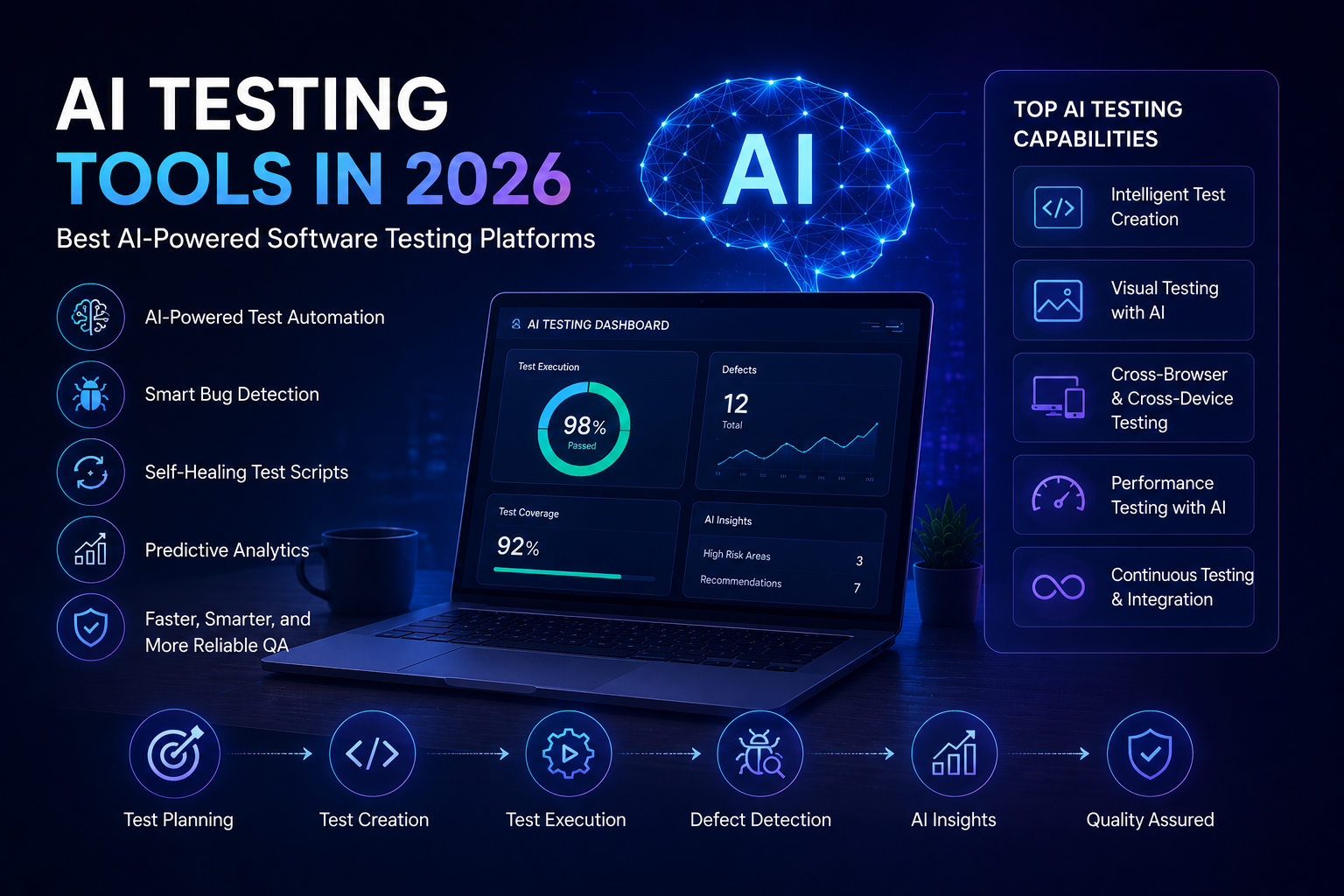
Software testing is evolving rapidly. Traditional automation frameworks are struggling to keep up with modern applications, frequent UI updates, and fast CI/CD release cycles. Businesses today release features faster than ever, but QA teams must ensure quality without slowing innovation.
This is where AI testing tools and AI-powered software testing are transforming the QA landscape. From self-healing automation to predictive defect detection, AI is helping enterprises accelerate releases while maintaining high reliability.
In this blog, we’ll explore what AI testing is, key benefits, top AI testing tools in 2026, and how to choose the right platform.
What is AI Testing?
AI testing is the use of artificial intelligence and machine learning to improve and automate software testing processes.
Unlike traditional scripted automation, AI testing tools can:
- Adapt to UI changes
- Reduce script maintenance
- Generate test cases automatically
- Detect risks and defect patterns early
This makes QA more scalable, intelligent, and efficient.
Key Features of AI Testing Tools
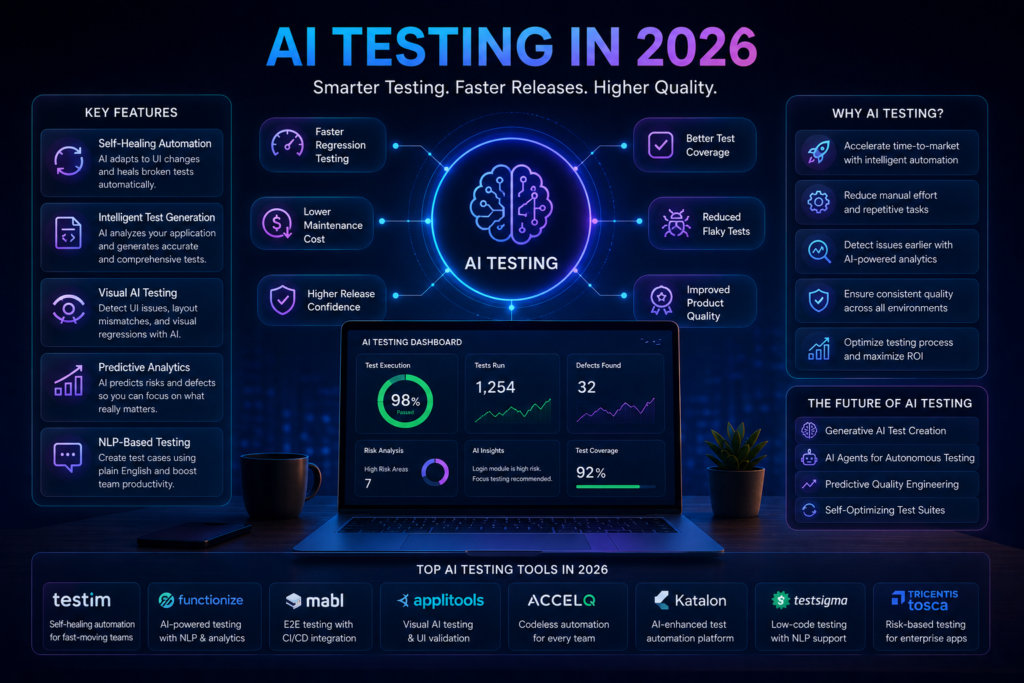
1. Self-Healing Automation
AI automatically detects UI changes and updates locators, reducing broken tests and maintenance effort.
2. Intelligent Test Generation
AI tools can generate functional, regression, and edge-case tests by analyzing user flows and application behavior.
3. Visual AI Testing
Visual testing detects UI layout issues, design inconsistencies, and cross-browser rendering problems.
4. Predictive Analytics
AI predicts high-risk modules based on defect history and code changes, helping teams prioritize testing smarter.
5. NLP-Based Testing
Some platforms allow teams to create test cases using plain English instructions, reducing dependency on coding.
Why AI is Transforming Software Testing in 2026
AI testing is becoming essential because it supports modern development environments with:
- Faster regression testing
- Reduced flaky tests
- Better test coverage
- Lower automation maintenance cost
- Higher release confidence
Enterprises adopting AI-driven QA are achieving faster time-to-market and improved product reliability.
Best AI Testing Tools in 2026
Here are some of the most popular AI-powered software testing tools enterprises are using:
1. Testim
Best for fast automation and self-healing test scripts.
2. Functionize
Enterprise-ready tool with NLP-based automation and advanced analytics.
3. Mabl
Strong for end-to-end testing with CI/CD and cloud-native workflows.
4. Applitools
Industry leader in visual AI testing and UI regression testing.
5. ACCELQ
Codeless automation tool suitable for teams with limited coding expertise.
6. Katalon
A balanced platform combining traditional automation with AI enhancements.
7. Testsigma
Low-code testing platform with NLP-based test creation and cross-platform support.
8. Tricentis Tosca
Enterprise-grade tool with risk-based testing and strong ERP/SAP automation capabilities.
Benefits of AI Testing for Enterprises
AI-powered testing offers clear advantages:
- Faster release cycles
- Reduced testing cost
- Lower script maintenance
- Higher automation accuracy
- Better scalability for large applications
- Improved customer experience
Challenges of AI Testing
While AI testing is powerful, organizations may face:
- Higher tool investment costs
- Training and adoption challenges
- Dependence on quality test data
- Integration complexity with existing CI/CD pipelines
AI testing should support QA teams, not replace human judgment in exploratory and usability testing.
How to Choose the Right AI Testing Tool
Before selecting an AI testing platform, evaluate:
- Budget and licensing cost
- Team technical skills (low-code vs code-based)
- Integration support with CI/CD tools
- Reporting and analytics features
- Scalability for future testing needs
The right tool depends on your organization’s QA maturity and application complexity.
Future of AI in Software Testing
In 2026 and beyond, AI testing is moving toward autonomy with trends like:
- Generative AI test creation
- AI agents for autonomous regression testing
- Predictive quality engineering
- Continuous self-optimizing test suites
The future of QA is intelligent, automated, and data-driven.
Conclusion
AI testing is no longer optional—it is becoming a core part of modern quality assurance. With self-healing automation, visual AI validation, predictive testing, and intelligent analytics, AI-powered QA tools help organizations ship software faster and with higher confidence.
Enterprises that adopt AI testing early will gain a competitive advantage through improved speed, scalability, and product quality.
About Pure Technology
At Pure Technology, we help organizations modernize QA through AI-driven automation, scalable testing frameworks, and DevOps-aligned quality engineering strategies.
Want to implement AI testing in your organization?
Get in touch with Pure Technology today.