
Agentic AI vs Generative AI: Understanding the Future of Intelligent Automation
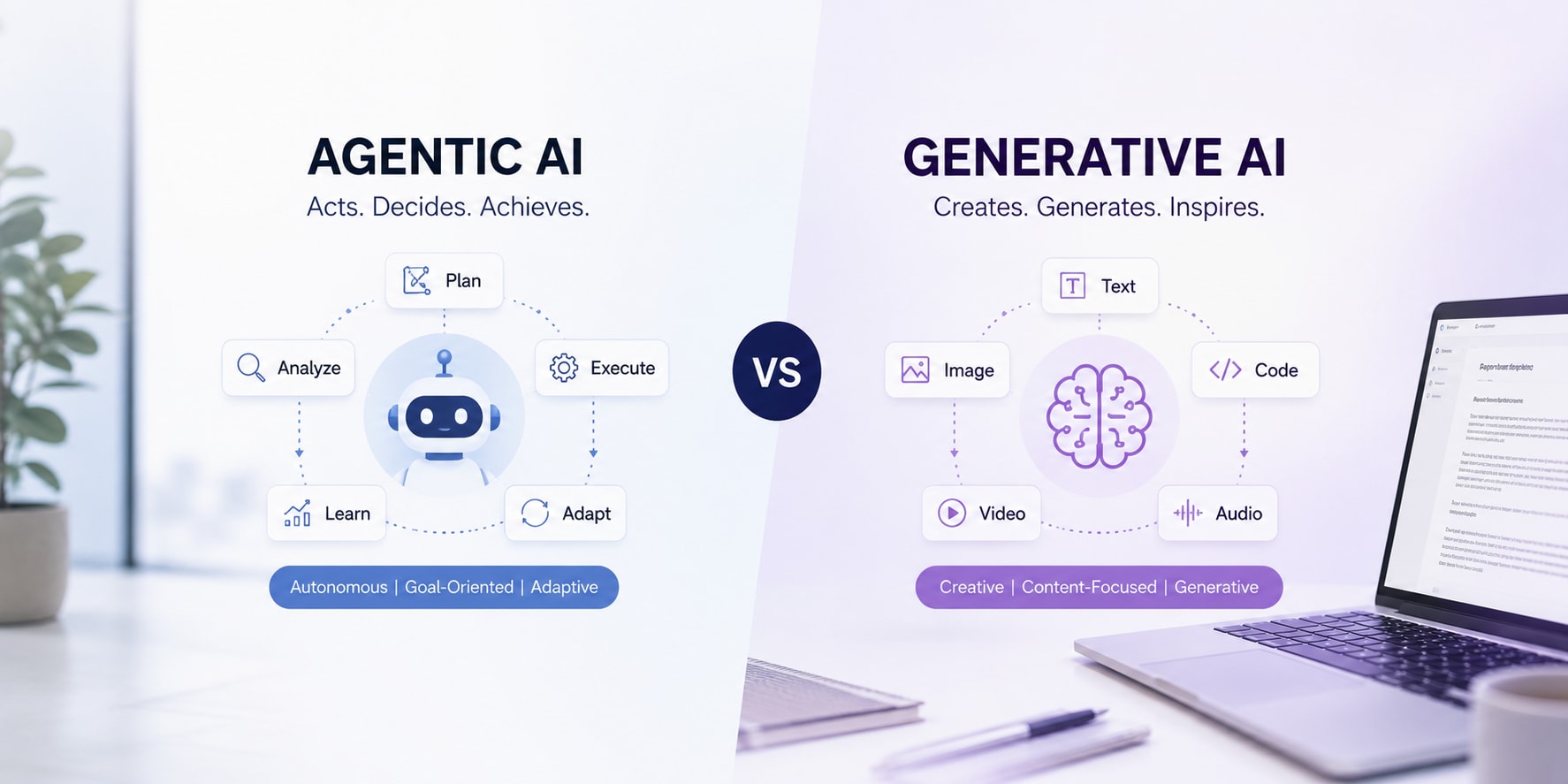
Artificial Intelligence is rapidly evolving from simple content generation to autonomous decision-making systems capable of performing complex tasks with minimal human involvement. Two major AI approaches leading this transformation are Generative AI and Agentic AI.
In this blog, we’ll explore the key differences between Agentic AI and Generative AI, their real-world applications, business benefits, and how organizations can choose the right AI approach for their needs.
What Is Agentic AI?
Agentic AI refers to intelligent systems capable of acting autonomously to achieve specific objectives. These AI agents can make decisions, initiate actions, remember past interactions, and adapt their behavior based on outcomes without requiring constant human input.
Unlike traditional AI systems that simply respond to prompts, Agentic AI can:
- Plan and execute tasks
- Interact with APIs and software tools
- Monitor workflows
- Learn from feedback
- Adapt to changing environments
Key characteristics of Agentic AI include:
- Autonomy
- Goal-oriented behavior
- Context awareness
- Memory retention
- Reasoning capabilities
- External system integration
Popular examples include AI workflow assistants, AutoGPT, Devin AI, and autonomous business automation agents.
What Is Generative AI?
Generative AI is a type of artificial intelligence designed to create new content such as:
- Text
- Images
- Videos
- Audio
- Code
- Designs
Popular examples of Generative AI include:
- ChatGPT
- DALL·E
- Midjourney
- GitHub Copilot
Generative AI is widely used for:
- Content creation
- Marketing copy
- Code generation
- Design assistance
- Translation
- Summarization
Businesses are increasingly adopting Generative AI services and solutions to improve productivity, automate creative tasks, and personalize customer experiences.
Key Differences Between Agentic AI and Generative AI
1. Goal Orientation
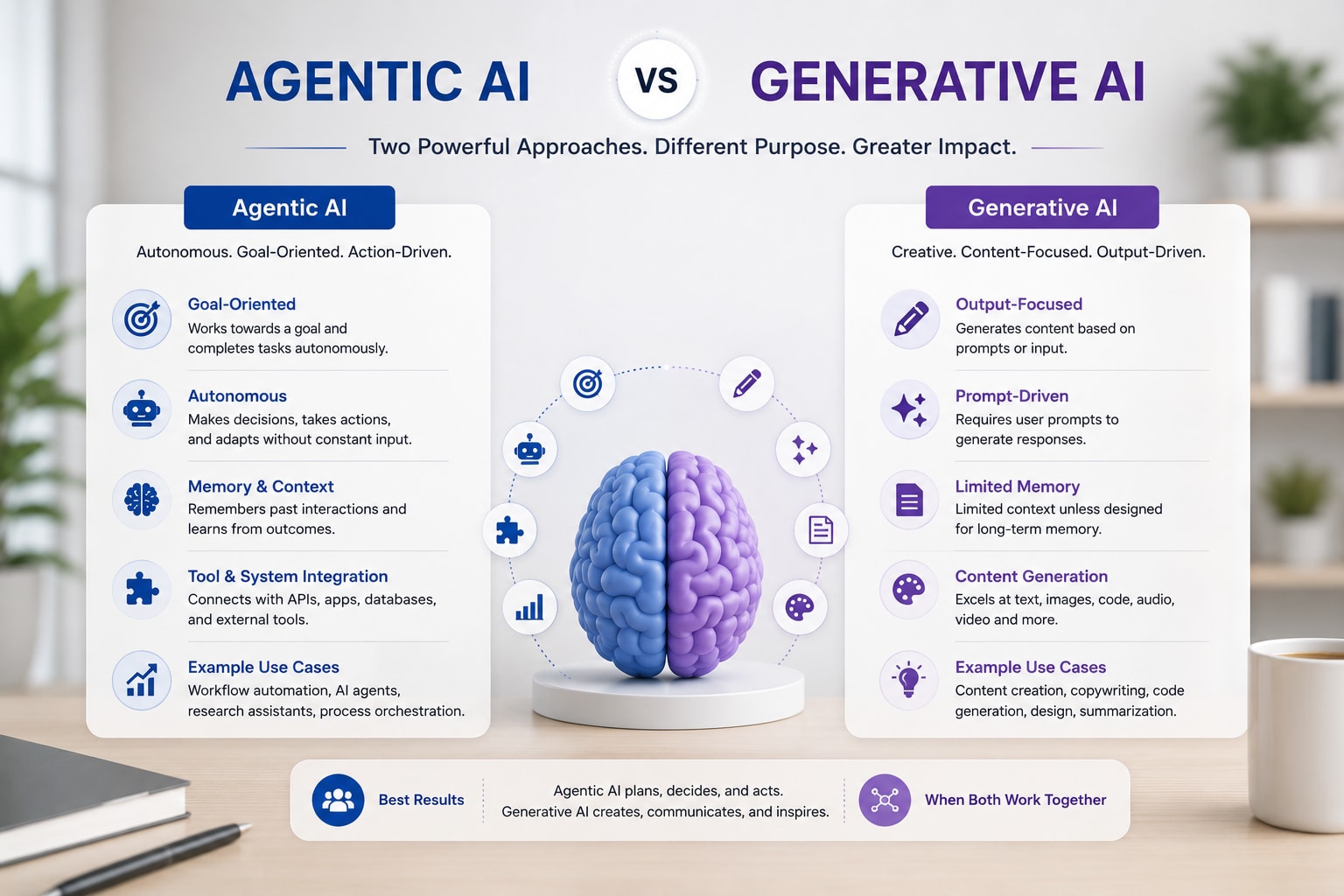
Agentic AI is goal-focused. Instead of simply generating outputs, it works toward completing a broader objective through multiple actions and decisions.
For example:
- Generative AI can write an email
- Agentic AI can plan, send, monitor, and follow up on that email campaign automatically
2. Autonomy
Generative AI typically reacts only when prompted by a user.
Agentic AI operates with a much higher level of autonomy. It can initiate tasks, evaluate outcomes, and adjust actions without continuous human involvement.
3. Memory and Context Awareness
Agentic AI systems often include long-term memory and contextual awareness. They can remember previous interactions, track workflows, and improve future decision-making based on historical data.
4. Tool Integration
Generative AI usually operates within a single interface and may require plugins for external connectivity.
Agentic AI is designed to interact with:
- APIs
- Databases
- Business software
- IoT devices
- CRM systems
- External applications
This enables autonomous task execution across multiple systems.
5. System Architecture
Generative AI often relies on a single-model architecture optimized for content generation.
Agentic AI uses a more advanced architecture that may include:
- Planning modules
- Memory systems
- Reasoning engines
- Execution frameworks
- Multiple AI models working together
This allows it to handle complex, multi-step workflows effectively.
How Agentic AI and Generative AI Work Together
Agentic AI and Generative AI are not competitors — they often work together within modern AI ecosystems.
In many cases, Agentic AI systems use Generative AI models to:
- Draft emails
- Generate reports
- Summarize documents
- Create responses
- Produce content dynamically
The Agentic framework manages planning, execution, and decision-making, while Generative AI handles content creation tasks.
Popular frameworks enabling this integration include:
- LangChain
- AutoGPT
- CrewAI
- MetaGPT
These hybrid systems are becoming increasingly important for enterprise automation and intelligent business operations.
Real-World Applications of Generative AI
Generative AI is transforming several industries through automated content creation and creative assistance.
Common applications include:
- Marketing content generation
- Blog writing
- Ad copy creation
- Design mockups
- UI/UX prototyping
- Code assistance
- Business documentation
- Video scripting
- AI-powered chatbots
Its ability to produce high-quality content quickly makes it valuable across marketing, software development, and customer engagement.
Real-World Applications of Agentic AI
Agentic AI focuses more on task execution and operational automation.
Key use cases include:
- Autonomous customer support
- AI sales assistants
- Workflow automation
- Research agents
- Software engineering assistants
- Intelligent project management
- Automated scheduling
- Supply chain coordination
Businesses using Agentic AI can significantly reduce manual work while improving efficiency and scalability.
Final Thoughts
Both Agentic AI and Generative AI are shaping the future of intelligent automation, but they solve different problems.
As AI technology continues to evolve, businesses that strategically combine both approaches will gain a significant competitive advantage through smarter automation, faster operations, and improved customer experiences.
At Pure Technology, we help businesses build scalable AI-powered solutions tailored to modern enterprise needs — from Generative AI applications to advanced Agentic AI systems and workflow automation platforms.
Connect with our experts today and explore how intelligent AI systems can transform your business operations.