
7 AI Trends Set to Redefine E-Commerce Over the Next 5 Years
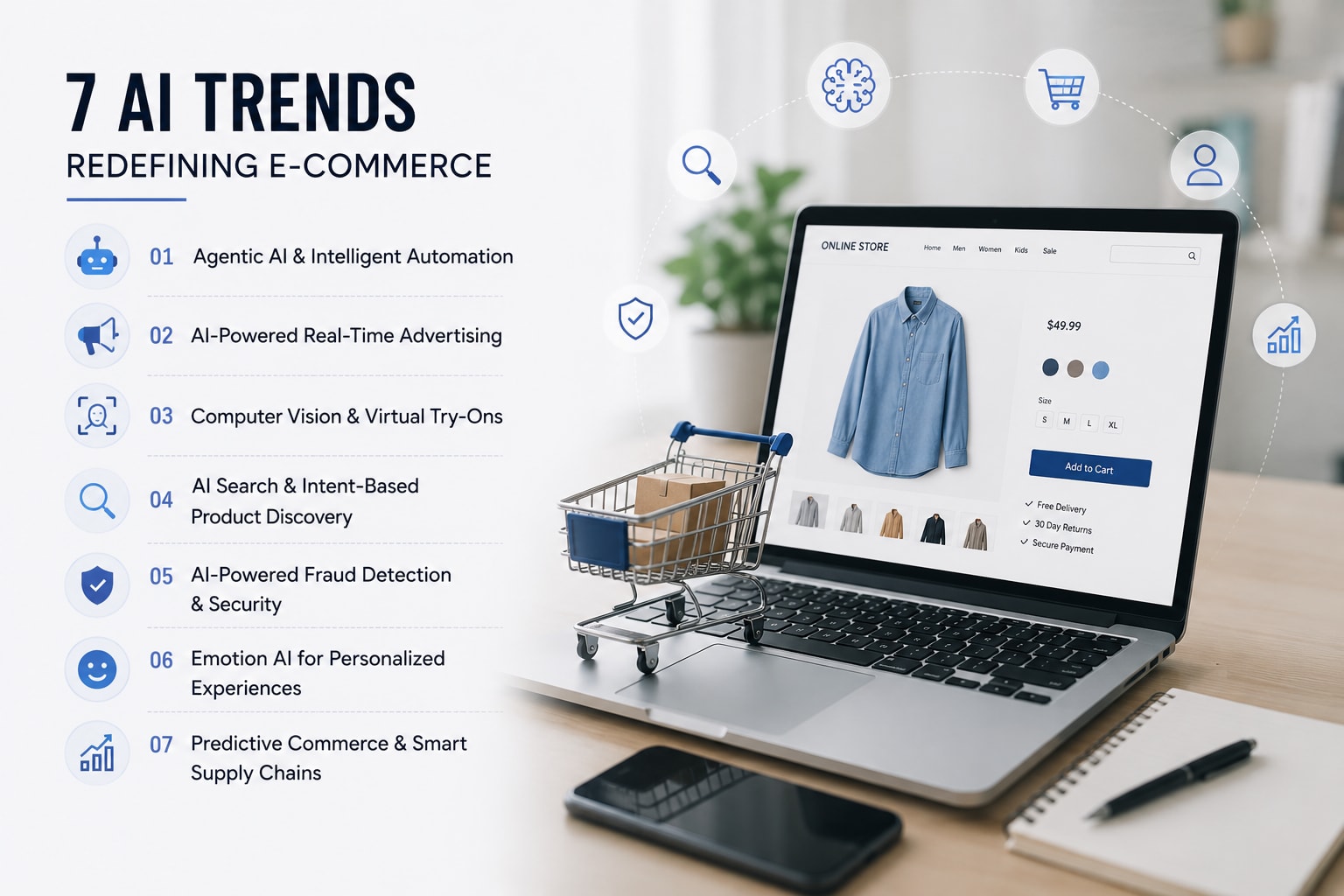
7 AI Trends Set to Redefine E-Commerce Over the Next 5 Years
Artificial Intelligence is no longer just an add-on in e-commerce — it is becoming the core engine driving customer experiences, operations, marketing, and supply chains. As online shopping continues to evolve, AI is helping businesses create smarter, faster, and more personalized digital commerce ecosystems.
1. Agentic AI Will Automate Decisions Across the Customer Journey
Agentic AI refers to intelligent AI systems that can independently make decisions, perform tasks, and interact with systems or users without constant human intervention.
Unlike traditional automation, agentic AI adapts to changing situations, understands context, and continuously improves based on data and customer interactions.
In e-commerce, these AI agents can:
- Handle returns and refunds automatically
- Resolve customer service queries
- Monitor inventory levels
- Trigger automated reordering
- Personalize shopping experiences in real time
For example, an AI agent can identify delayed shipments, communicate with logistics providers, and proactively update customers without manual involvement.
At Pure Technology, we see agentic AI becoming one of the most impactful technologies for businesses aiming to reduce operational costs while improving customer satisfaction.
2. AI-Powered Ads Will Adapt to Real-Time Buyer Behavior
Traditional advertising relies heavily on demographics. AI-driven advertising is shifting toward behavior-based personalization.
Modern AI systems analyze:
- Browsing patterns
- Session duration
- Purchase history
- Click behavior
- Product engagement
This allows brands to create highly personalized ad experiences based on customer intent.
For instance:
- Impulse buyers may see urgency-driven offers
- Research-oriented shoppers may see comparison guides and reviews
- Returning visitors may receive loyalty-based promotions
Real-time ad optimization helps brands improve conversions while reducing wasted ad spend.
Businesses investing in advanced e-commerce development services are increasingly integrating AI-powered ad personalization into their growth strategies.
3. Computer Vision Will Transform Virtual Try-Ons
Computer vision technology is making online shopping more immersive and accurate.
Instead of simple AR overlays, AI-powered body mapping systems now analyze:
- Body dimensions
- Facial structure
- Posture
- Skin tone
- Movement patterns
This enables realistic virtual try-ons for:
- Fashion products
- Eyewear
- Cosmetics
- Footwear
- Accessories
The biggest advantage is reduced product returns caused by incorrect sizing or unmet customer expectations.
As AI and computer vision technologies continue to mature, virtual fitting rooms will become a standard feature in modern e-commerce experiences.
4. AI Search Will Shift Toward Intent-Based Product Discovery
Keyword-based search is no longer enough for modern e-commerce platforms.
AI-powered search engines now use:
- Natural Language Processing (NLP)
- Semantic search
- Behavioral learning
- Context analysis
This allows systems to understand search intent instead of just matching keywords.
For example, searches like:
- “Affordable summer outfits under $50”
- “Minimalist office desk for small rooms”
- “Running shoes for flat feet”
can generate highly relevant results even if exact keywords are missing.
Intent-based search improves:
- Product discovery
- Conversion rates
- Customer satisfaction
- Mobile shopping experiences
AI-driven search optimization is becoming essential for businesses managing large product catalogs.
5. AI-Powered Fraud Detection Will Strengthen E-Commerce Security
As digital commerce grows, fraud attacks are becoming more sophisticated.
AI-powered fraud detection systems can analyze thousands of behavioral signals in real time, including:
- Login patterns
- Device activity
- Payment behavior
- Location data
- Transaction history
These systems identify suspicious activity instantly and reduce risks such as:
- Account takeovers
- Payment fraud
- Fake returns
- Identity theft
Unlike rule-based systems, AI continuously learns from new fraud patterns and adapts automatically.
This helps businesses improve security while maintaining a smooth customer experience.
6. Emotion AI Will Personalize Shopping Experiences Further
Emotion AI is emerging as a powerful trend in customer experience optimization.
This technology analyzes emotional signals from:
- User interactions
- Chat conversations
- Reviews
- Voice tone
- Behavioral patterns
Combined with behavioral analytics, businesses can understand not only what customers do but also how they feel during the shopping journey.
For example:
- Hesitant shoppers may receive reassurance through reviews or offers
- Frustrated users may get instant support assistance
- Engaged buyers may receive upsell recommendations
Emotion-aware digital experiences will help brands create stronger emotional connections with customers in the coming years.
7. Predictive Commerce Will Revolutionize Supply Chain Management
AI-powered predictive commerce is helping businesses move from reactive operations to proactive decision-making.
Modern AI systems analyze:
- Customer demand
- Weather patterns
- Social trends
- Inventory movement
- Supplier performance
- Regional buying behavior
This enables businesses to:
- Predict demand spikes
- Optimize inventory distribution
- Reduce stock shortages
- Improve delivery efficiency
- Minimize operational costs
Predictive AI also helps brands respond faster to market disruptions and changing customer behavior.
For growing e-commerce businesses, predictive commerce will become a major competitive advantage.
At Pure Technology, we help businesses build AI-powered e-commerce solutions that improve customer experiences, streamline operations, and drive long-term growth.